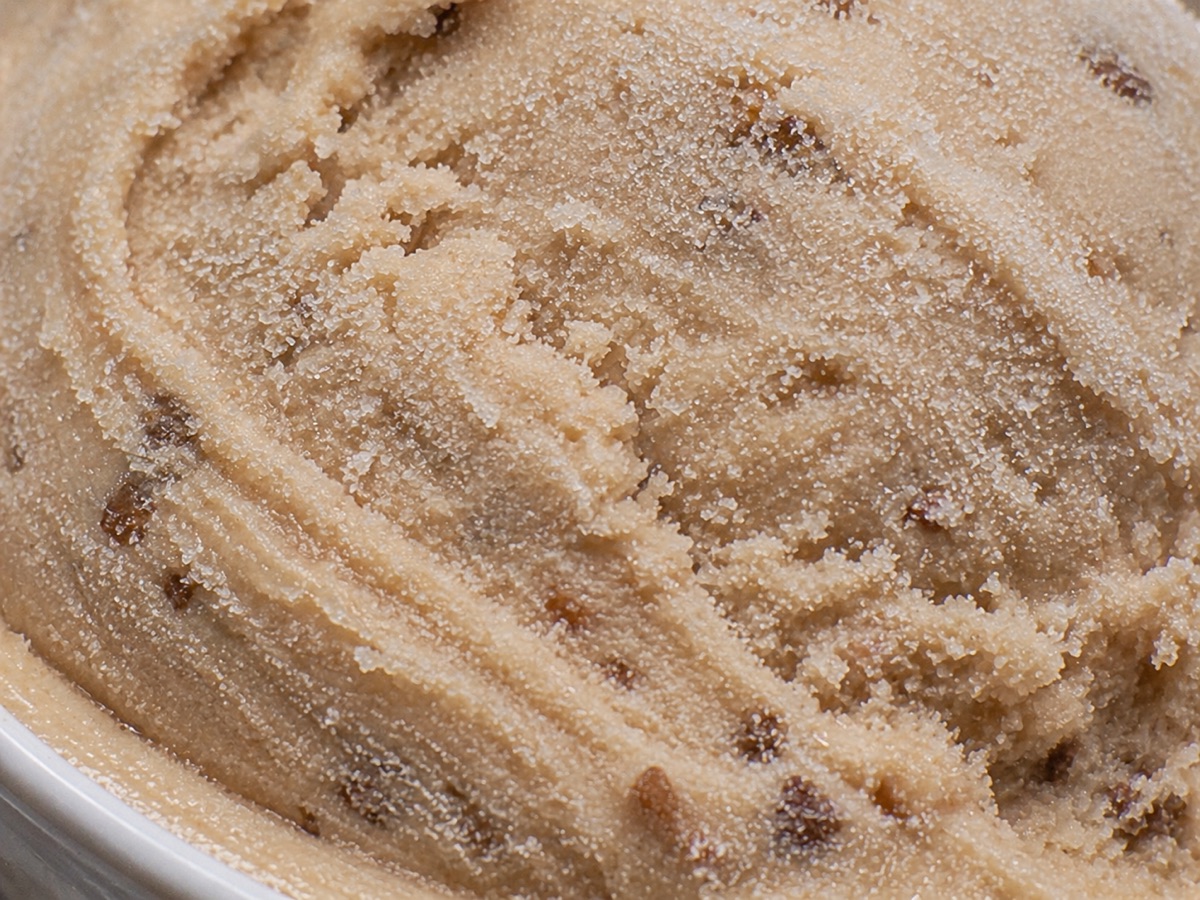
You churned the base, packed it into a tub, and went to bed dreaming of soft, dense scoops. The next afternoon you pulled it out and found something else: a brick that crunches under the spoon, with frost on top and tiny shards of ice instead of cream. So why is your gelato icy?
The honest answer is that "icy" is a symptom with at least five different causes, and most online troubleshooting articles just hand you a list of fixes ("add more solids", "use stabilizers") without telling you which one is yours. This guide is a diagnostic. We'll work through the five root causes in order of how often they're the actual culprit, give you the exact threshold to hit for each, and show how GelatoLator flags the recipe-side problems in red so you can stop guessing.
What "Icy" Actually Means
Before fixing anything, look at the texture more closely. Three patterns point to different causes:
- Hard and crunchy throughout - the gelato is rock-solid, and every bite has gritty ice. Usually a recipe problem: not enough total solids, not enough anti-freezing power, or both.
- Soft enough but grainy - you can scoop it, but it tastes sandy on the tongue. Usually a process problem: the base froze too slowly, or there's no stabilizer to keep crystals small.
- Frost or ice film on top after a day or two - the body underneath is fine. Almost always a storage problem: water migrating to the surface as the freezer cycles.
Knowing which pattern you have narrows the fix from "all five things" to one. Now to the causes themselves.
Cause #1: Not Enough Solids
Gelato is mostly water. The solids - fat, milk solids, sugar, stabilizer - are what get between water molecules and stop them from forming big, crunchy ice crystals. When total solids drop below ~32%, there's too much free water, and free water freezes hard.
How to spot it
In GelatoLator, the Total Solids card shows red when you're below the 32–42% target. The texture in the freezer is hard, brittle, and crunchy from the first scoop.
What to change
Aim for total solids of 36–40% for a forgiving home batch. The cheapest, fastest fix is skim milk powder: it's almost pure milk solids (no fat, no water), so 20–30 g per 1 kg of mix lifts both total solids and MSNF in one shot. If you're already maxed on milk powder and still low, replace some whole milk with light cream - you'll add fat alongside the solids, which is fine as long as fat stays under 12%.
Open GelatoLator and check your total solidsCause #2: Low Anti-Freezing Power
PAC stands for Potere Anti-Congelante - Italian for "anti-freezing power". It tells you how much the dissolved sugars and alcohols depress the freezing point of the mix. Higher PAC = softer at freezer temperature = smaller, finer ice crystals.
When PAC is too low, two things happen at once: the gelato freezes too hard to scoop, and because it's so hard, you only ever serve it after partial thawing - which lets ice crystals re-grow into the gritty kind you can crunch.
How to spot it
In GelatoLator, the PAC card shows red when you're below the 22–28 target band. Symptom in the freezer: you have to leave the tub on the counter for 10–15 minutes before a scoop will give. By then, the surface has melted and re-frozen, and that's where the iciness comes from.
What to change
The trick is to swap some sucrose for a sugar with higher PAC, without making the gelato sweeter:
- Dextrose - PAC 190 vs sucrose's 100, and it's only 70% as sweet. Replace 30–50 g of sucrose per 1 kg of mix with dextrose and PAC jumps several points with no sweetness penalty.
- Invert sugar or glucose syrup DE60 - also raises PAC, slightly different flavor and mouthfeel.
A common rookie mistake is to just add more sugar without swapping types. That raises PAC, but also raises sweetness - and if SP (Sweetening Power) climbs above ~21, the gelato tastes cloying. The whole point of dextrose is that you can lift PAC while keeping SP roughly flat - see the first balancing tip in How It Works.
Cause #3: No Stabilizer
Stabilizers are hydrocolloids - guar gum, locust bean gum, carrageenan, sometimes gelatin - that bind free water into a gel network. They don't stop water from freezing; they stop ice crystals from growing during storage. Without one, even a perfectly balanced recipe will turn grainy after 24 hours in the freezer as small crystals merge into bigger ones (a process called recrystallization).
How to spot it
Fresh out of the churner, the gelato is fine. After a night in the freezer, it's still soft enough to scoop, but the texture has gone sandy - you can feel grit on your tongue without ever crunching.
What to change
Add a stabilizer at 0.2–0.5% of total mix weight. Concretely:
- For 1 kg of base: 2–5 g of a gelato stabilizer blend, or 2 g of guar gum on its own, or 1 g LBG + 1 g guar.
- Mix the stabilizer dry with the sugar before adding it to the liquid. Otherwise it clumps into rubbery beads that never hydrate properly.
- Heat to 70–85 °C while stirring to fully hydrate the gum, then chill the base overnight (the chill phase is when the network actually forms).
Egg yolks (3–4 yolks per kg) act as a natural stabilizer too, via lecithin. They're not as effective at suppressing recrystallization as a gum blend, but they help - and they shift flavor toward custard, which some people prefer.
Cause #4: Slow Freezing
Even with a perfect recipe, how fast the base freezes matters enormously. Fast freezing produces many tiny crystals; slow freezing produces fewer, bigger, crunchier ones. Most home gelato disasters happen here.
How to spot it
This one isn't in the calculator - it's about your equipment and process. Telltale signs: your base goes into the machine warm or barely cool; the bowl was in the freezer less than 24 hours; or your churn took 40+ minutes to thicken.
What to change
- Chill the base for 12–24 hours in the fridge before churning. This isn't optional - it ages the proteins and stabilizers (better mouthfeel) and it puts the base 20+ °C closer to freezing, so the machine has less work to do.
- Pre-freeze the machine's canister for at least 24 hours if you have a freezer-bowl machine. A bowl that wasn't fully solid before you started will let the base freeze slowly from the outside in - exactly the wrong direction.
- Don't overload the machine. A 1.5 L machine with 1.4 L of base will not freeze fast enough; aim for 60–70% of rated capacity.
- Pre-chill the storage tub in the freezer for 30 minutes before you transfer the churned gelato into it. A room-temperature tub bleeds heat back into the gelato on contact and slows the final freeze; a cold tub doesn't.
- Move the gelato to the freezer immediately after churn (a process called blast freezing in the trade). Every minute it spends warm at room temperature is a minute when crystals can grow.
- Set your freezer to its coldest setting for at least the first hour after churn. Switch back to normal afterward if you want a softer scoop.
If you're still getting slow churns after all of the above, the bowl may be losing capacity (most freezer bowls fade after 50–100 cycles) or the freezer itself isn't cold enough. An inexpensive digital freezer thermometer will tell you in an afternoon.
Cause #5: Bad Storage
Even balanced, well-frozen gelato will go icy if you store it badly. The freezer is a wet environment that cycles - it warms briefly during defrost, water vapor settles on whatever's coldest (your gelato), and refreezes as a thin frost layer. Repeat for a week and the top centimeter of your tub is ice.
How to spot it
The body of the gelato is fine. The top - the part you scoop first - is crusted, frosty, or has visible ice crystals.
What to change
- Use a shallow, airtight tub with a tight lid. The smaller the surface area exposed to air, the less moisture can settle.
- Press a piece of parchment paper directly onto the surface before putting the lid on. This single trick dramatically reduces surface frost, because moisture deposits on the parchment instead of on the gelato.
- Keep the freezer below −18 °C and avoid the door (where temperature swings are biggest).
- Don't leave the tub on the counter. Every freeze-thaw cycle kills texture. Scoop fast, lid back on, back in the freezer.
- Eat it within 2 weeks. Home freezers run too warm and cycle too much for gelato to keep its texture for a month.
A Worked Example: Icy → Balanced
Here's a recipe that produces classic icy gelato:
| Ingredient | Weight |
|---|---|
| Whole milk (3.25%) | 700 g |
| Heavy cream (36%) | 100 g |
| White sugar | 160 g |
| Vanilla extract | 5 g |
Drop this into GelatoLator and you'll see three flagged metrics: MSNF ≈ 6.6% (red, well below the 7–13% target), Total Solids ≈ 29.2% (red, below the 32–42% band), and PAC ≈ 22 (sitting right at the bottom of the 22–28 target — workable but tight). Plus there's no stabilizer at all. This recipe will be hard, crunchy, and grainy by day two.
The fix - three changes:
- Add 40 g of skim milk powder. Pushes MSNF into the green and lifts total solids close to range.
- Replace 40 g of sucrose with 40 g of dextrose. Lifts PAC into the green with no change in sweetness.
- Add 2 g of guar gum, mixed into the sugars before heating. Locks in fine ice crystals during storage.
Final balance: MSNF 10.1%, PAC 26.3, SP 15, Total Solids 32.1% (all green), and the stabilizer is now in. Same vanilla flavor; completely different texture.
Build the balanced version in GelatoLatorQuick Reference: Match the Symptom to the Fix
| Symptom | Likely cause | Fix |
|---|---|---|
| Hard, crunchy from day 1 | Low total solids and/or low PAC | +40 g skim milk powder; swap 40 g sucrose → dextrose |
| Soft but grainy on the tongue | No / weak stabilizer, or slow freeze | +0.2–0.5% stabilizer blend; pre-chill base 12 h |
| Fine fresh, sandy by day 2 | No stabilizer, slow recrystallization | +0.2–0.3% guar gum, mixed dry with sugar |
| Frost / ice film on top only | Storage | Parchment on surface, airtight tub, freezer ≤ −18 °C |
| Has to thaw 15 min before scooping | PAC too low | Swap some sucrose → dextrose; aim PAC 22–28 |
The Bigger Picture
Most "why is my gelato icy" answers on the internet are right and incomplete. They're right that you need solids, that you need a stabilizer, that you should chill the base. They're incomplete because they don't tell you which one is your problem, or how much to add.
That's the gap GelatoLator was built to fill. Drop your recipe in, look at the seven metric cards, and the red ones tell you where the problem lives - before you waste another 2 kg of milk on a batch that comes out icy. Once you've fixed the recipe-side issues, the process-side fixes (chill, freeze fast, store cold and tight) get you the rest of the way.
If you want a deeper dive into what each metric actually controls, read How GelatoLator Works. And if you have a recipe you found online and you're not sure whether it'll come out icy before you make it, our recipe-conversion guide walks you through the diagnostic from start to finish. Or if you want to skip the diagnostic entirely and start from a base that's already balanced, The Ultimate Vanilla Gelato Base gives you two pre-tuned recipes (egg and eggless) with every metric already in the green - useful as a reference point even if you don't end up making vanilla.
Working on the fruit-sorbet side instead? The same diagnostic structure - five causes, exact thresholds, calculator screenshots - is in Why Is My Sorbet Too Hard?, with the sorbet-specific math (no MSNF, fruit PAC ×1.9, the all-sucrose trap) worked out.