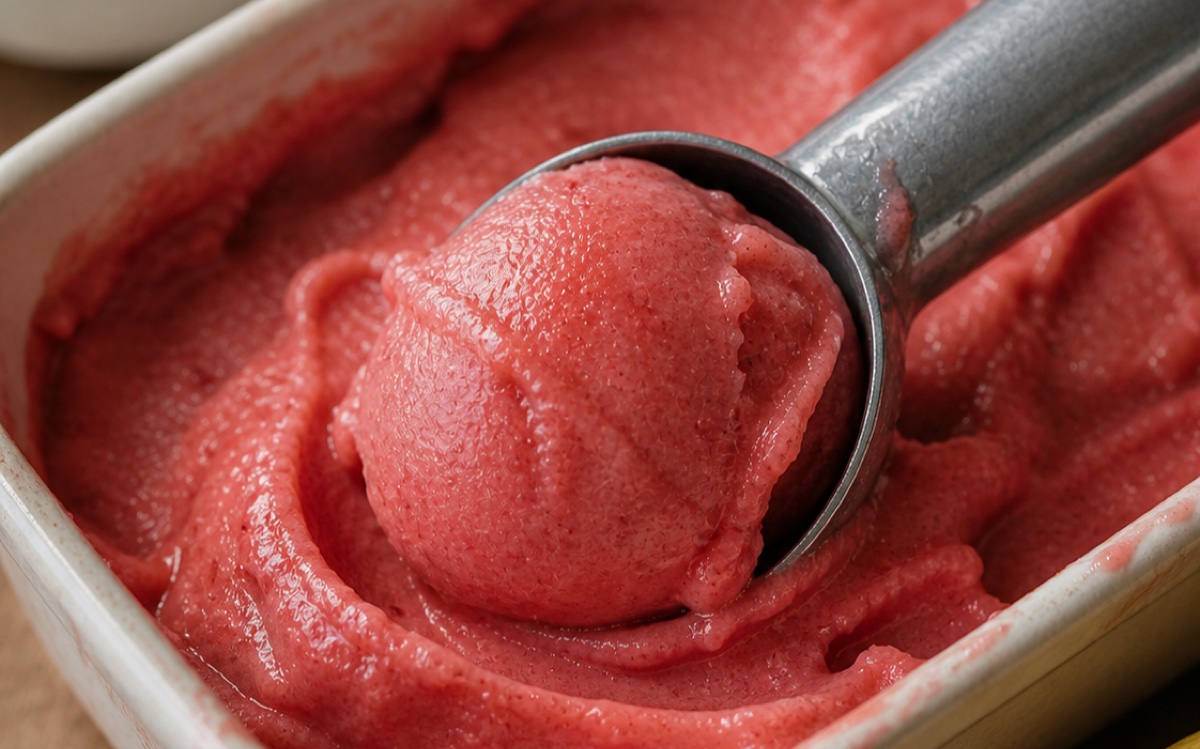
A balanced fruit sorbet wants 22–30% sugar by weight. Most blog recipes land at 15–18%. That single gap is the difference between a scoop that lifts cleanly and a tub you have to chip at with the back of a spoon - and it's the reason your strawberry sorbet came out of the freezer as a mineral specimen.
Sorbet has no margin for error. There's no dairy fat absorbing heat, no milk solids tying up free water, no protein network buffering the freeze. There's water, sugar, fruit pulp, and (if you remembered) a stabilizer. The sugar isn't there for sweetness - it's the anti-freeze. Run the numbers wrong and you've made a popsicle. Run them right and you've made dessert.
Most online "hard sorbet" advice is either too vague ("add more sugar") or too narrow ("a tablespoon of vodka fixes it"). The truth is more interesting: most hard sorbets fail in the same place - the sugar - but the kind of sugar problem varies, and a smaller fraction fail somewhere else. This guide walks the diagnosis in priority order, so you can find your fix in two minutes instead of throwing the whole recipe out.
First, Check Your Sugar
Most home sorbet problems are sugar problems. Either there isn't enough total sugar, or there's enough total sugar but it's all sucrose. Both produce a hard tub; they look almost the same in the freezer; they have different fixes. Both are visible in GelatoLator the moment you switch the recipe type to Fruit Sorbet (the badge next to the recipe title) and the calculator pulls up sorbet-specific thresholds: sugar 22–30%, PAC 30–42, total solids 28–35%.
Are you below 22% total sugar?
That's the first thing to check. The sugar you weighed into the bowl plus the sugar already inside the fruit (about 6–9% for berries, 12–14% for stone fruit, 18–20% for banana) needs to clear 22% of total mix weight. Most internet recipes don't add up that high. They were written for sucrose alone in water, not for the home freezer at –18 °C, and they leave you with a sorbet that only feels soft in the half-second after it leaves the counter. GelatoLator's Sugar card already counts the fruit's sugar contribution, so the percentage you see is the real one.
Is the sugar percentage fine but PAC is still red?
Then it's the type of sugar. Sucrose has a PAC of 100 - the baseline. Dextrose has a PAC of 190. Glucose syrup, invert sugar, and fructose sit between. A sorbet at 25% sucrose by weight lands at PAC ~28–29; at 25% sugar split 75/25 sucrose/dextrose, PAC jumps to ~35–37 with the sweetness actually dropping slightly (dextrose is only ~70% as sweet as sucrose). This is why blog recipes that say "use ripe fruit and a little simple syrup" produce hard sorbet even when the total sugar looks reasonable: it's the wrong sugar.
The fix is almost always the same shape: swap 20–30% of the sucrose for dextrose. For a recipe with 200 g of added sugar, that's 140–160 g sucrose plus 40–60 g dextrose. PAC climbs into the green band, sweetness stays roughly flat or drops slightly (which most palates prefer for fruit sorbet - the fruit gets to lead), and the texture you remembered from a Sicilian gelateria starts showing up in your kitchen.
GelatoLator does one piece of the math that most recipes skip: in Fruit Sorbet mode, fruit-sugar PAC is multiplied by 1.9, because the fructose and glucose in fruit depress the freezing point harder than sucrose does. You don't need to track this; the PAC card just reads correctly when fruit is involved.
If the Sugar's Right and It's Still Hard, Look at the Fruit
Sometimes you fix the sugar and the sorbet is still cold-shoulder hard. The next place to look is your fruit-to-water ratio. Fruit isn't only flavor in a sorbet - it's structure. Pulp brings non-sugar solids (fiber, pectin, cell-wall fragments) that interfere with ice-crystal formation in much the same way milk solids do in dairy gelato. A sorbet built on fruit juice with sugar and water added will always be icier than one built on fruit puree at identical PAC.
The trap is recipes that lean heavily on water to stretch expensive fruit. 400 g puree + 400 g water + 200 g sugar looks reasonable on paper and produces a tub of flavored ice. Total solids land around 22%, well below the 28–35% sorbet target band, and the result shatters into shards instead of yielding to a scoop. In GelatoLator the Total Solids card sits in red, even after you've fixed the sugar.
The shape of the fix is to drop water and increase puree until total solids land in the green:
- Strawberry, raspberry, blackberry - 6–9% sugar, lots of pulp. Forgiving. About 70% puree + 25% sugar (sucrose+dextrose) + a squeeze of lemon works almost every time. No added water needed.
- Mango, peach, apricot - 12–14% sugar, dense pulp. Reduce the added sugar accordingly; GelatoLator's Sugar card will warn you if total sugar climbs past 30%.
- Watermelon, pineapple, citrus - 8–12% sugar, mostly water. Need help: reduce the juice on the stove by 30–40% to concentrate it, or add 1–2% inulin / 0.2% pectin to compensate for missing structure.
- Banana - 18–20% sugar, very dense pulp. Naturally creamy sorbets; usually need less added sugar than a recipe suggests, not more.
A second small thing while you're at it: strain raspberry, blackberry, and citrus purees through a fine-mesh sieve before you balance the recipe. Pulp builds body; seeds and fibrous bits build grit. The texture difference is bigger than people expect.
Day-2 Problems Are Different
A sorbet that's fine straight out of the churner but goes hard and gritty by the next morning has a different problem from one that came out wrong on day one. Two things drive day-2 deterioration: missing stabilizer (so ice crystals merge into bigger ones during storage) and bad storage (so freezer cycling adds frost on top and compounds the cycle). Together they're what make most homemade sorbets unpleasant after the first 24 hours.
Stabilizer
Hydrocolloids - guar gum, locust bean gum, pectin, sometimes xanthan - bind free water into a gel network. They don't stop water from freezing; they stop ice crystals from growing during storage. In sorbet this matters more than in gelato, because there's no fat globule network to slow recrystallization. The gel network is your only line of defense.
Add a stabilizer at 0.2–0.3% of total mix weight - for 1 kg of base, that's 2–3 g of guar gum, or 1.5 g guar + 1 g LBG, or a dedicated sorbet blend. Mix it dry with the sugar before adding to the liquid (otherwise it clumps into rubbery beads), heat to 70–85 °C while stirring to fully hydrate, and chill the base overnight before churning. Pectin (0.2–0.4%) is the natural choice for fruit sorbet - many fruits already contain it, and a small added dose integrates cleanly. For low-acid fruits (banana, melon) a touch of lemon juice helps the pectin set.
Storage
A freezer cycles. It warms briefly during defrost; water vapor settles on whatever's coldest (your sorbet); refreezes as a thin frost layer. Repeat for a week and the top centimeter is ice and the body has hardened from repeated micro-thaws. The fix is small habits, not new equipment: a shallow airtight tub instead of a tall one, a piece of parchment paper pressed directly onto the surface before the lid goes on, the freezer set below –18 °C, and the tub put back the moment you finish scooping. Sorbet keeps its texture for 1–2 weeks at home, not the indefinite "best by" date you see on commercial pints. Eat it.
A Quick Note for Ninja Creami Owners
If you're making sorbet in a Creami, the diagnostics above still apply - the 22–30% sugar target, the dextrose swap, the fruit ratio - but the machine compensates for one of them. A Creami pre-freezes the base solid, then shaves it into micro-particles on the way out. That's a different physics from churning, and it lets you get away with somewhat less stabilizer and somewhat thicker bases without the gritty end-state. What it can't fix is too little sugar or too little fruit pulp. Those still produce a brick that the Creami will happily shave into a snow cone, not a scoop. Get the sugar and the fruit ratio right first; the Creami handles the rest.
The other Creami-specific habit worth mentioning: if a sorbet comes out icy, you can re-spin without re-thawing, and texture usually rescues itself. Other machines don't give you that affordance.
What a Sorbet That Scoops Looks Like
To make all of this concrete, here's a strawberry sorbet recipe that lands in the green on every metric in Fruit Sorbet mode:
| Ingredient | Weight |
|---|---|
| Strawberry puree (strained) | 700 g |
| White sugar (sucrose) | 160 g |
| Dextrose | 60 g |
| Lemon juice | 15 g |
| Stabilizer blend | 2 g |
| Inulin | 15 g |
| Water | 50 g |
Total weight: 1002 g. In GelatoLator (Fruit Sorbet mode): Sugar 26.9%, Total Solids 28.7%, PAC 36.6, SP 25.1, serving temperature –14.6 °C - every card green. The inulin is doing real work here: it lifts total solids into the target band without adding sweetness, which sucrose alone can't do at the same percentage. Procedure is unfussy: warm the water with the sugar/dextrose/stabilizer/inulin (pre-mixed dry) to ~80 °C until the stabilizer is fully dispersed, cool, blend with the strained strawberry puree and lemon juice, chill the base overnight, churn cold, transfer to a shallow tub with parchment on top, freeze.
The point of presenting it this way isn't that this exact recipe is the One True Strawberry Sorbet - it's that the numbers in the calculator tell you, before you turn on the stove, whether the recipe will work. Drop your recipe in. If a card goes red, the section above tells you which knob to turn.
Open this recipe in GelatoLatorWhere to Go Next
If you want a deeper read on what each of the seven metric cards is actually measuring, How GelatoLator Works walks the whole panel. The dairy-gelato counterpart to this article - same flow, different physics - is Why Is My Gelato Icy?. And if you've got an internet recipe you want to vet before committing two pints of fruit to it, How to Balance a Gelato Recipe shows the workflow end to end. For a starting point on the dairy side, The Ultimate Vanilla Gelato Base pairs two pre-balanced bases (egg + eggless) with the same calculator-validated workflow used here.