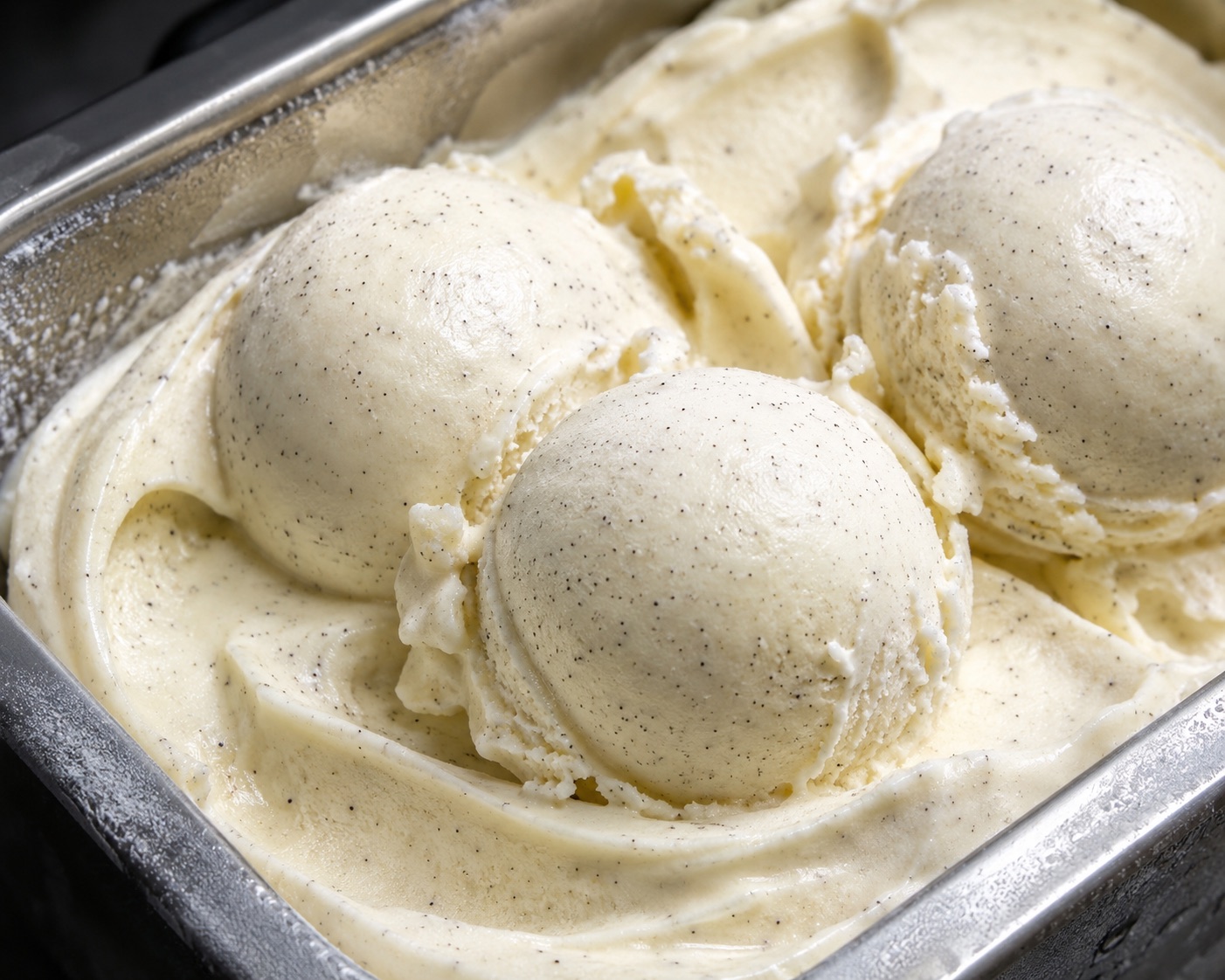
Vanilla gelato is the Italian frozen dessert in its simplest, most demanding form: milk, cream, sugar, and vanilla, churned at warm temperatures into a denser, less aerated cousin of ice cream. The recipe is short, the technique is forgiving, and the texture is brutal to fake. A balanced vanilla gelato base hits roughly 7-9% fat, 9-11% milk solids non-fat (MSNF), 16-20% sugar, and 36-40% total solids, with a PAC (anti-freezing power) of 22-28 and an SP (sweetening power) of 14-18. Get those numbers in range and the result scoops cleanly, melts slowly, and tastes of dairy and vanilla rather than cold sweetness. Get them wrong and you get the brick-of-flavoured-ice most home cooks end up scraping with a knife.
Most online vanilla gelato recipes don't publish those numbers. This one gives you two complete, pre-balanced bases - one classic egg-yolk gelato alla crema, one eggless vanilla built on fior di latte - with the metrics shown, the technique walked through, and a calculator you can load each recipe into to tweak without breaking the balance.
What Is Gelato di Crema?
Gelato di crema (also called gelato alla crema) is the Italian name for the classic egg-yolk vanilla gelato base - the egg-and-dairy custard that anchors most Italian gelaterie's flavour menu. Traditionally it is just four ingredients - milk, cream, sugar, and egg yolks - with vanilla as the standard flavouring (the balanced home version in Recipe A adds milk powder, dextrose, and a touch of stabilizer to hold texture in a domestic freezer). The yolks do two jobs: their fat enriches the body, and their lecithin emulsifies the mix so the base feels silken rather than separated. Compared with American ice cream it carries less fat (7-9% vs 14-18%) and more milk solids non-fat (9-11% vs ~10%), which is why gelato di crema tastes more of dairy and less of cream. It is churned at low overrun (20-35% incorporated air, vs ice cream's 60-100%), giving the dense, almost paste-like texture that scoops in soft ribbons rather than fluffy peaks. It is served warmer than ice cream - around -14 °C in commercial cabinets, which is several degrees above a home freezer.
What Is Fior di Latte?
Fior di latte (literally "flower of milk") is the eggless counterpart to gelato di crema. The classic Italian artisan technique relies on a small amount of stabilizer blend — typically locust bean gum and guar gum at about 0.3–0.4 % of the total mix weight — to provide body and bind free water without egg yolks. The result is a brighter, milkier flavour because no yolk fat carries the dairy, and a cleaner finish on the tongue. It is the canonical Sicilian-style gelato and arguably the better base when you want vanilla to come forward; with egg yolks present, vanilla competes with custardy notes. Nutritionally the differences are small: fior di latte typically runs ~7–8% fat, ~9–10% MSNF, ~36–38% total solids, very close to gelato di crema, but with no eggs. It also keeps better in the freezer than an unstabilised eggless gelato because the stabilizer's gel network slows ice-crystal regrowth during storage. (Some American home-cookbook adaptations use cornstarch instead of a stabilizer blend — recognisable, but not how Italian gelaterie actually work.)
Two Pre-Balanced Bases
Both recipes below target the green zone in GelatoLator and are scaled to a 1 kg (about 8-serving) batch. Each ingredient is weighed in grams - if you cook gelato by volume, the numbers come apart. Pick whichever base fits your evening: egg-based for richness and a classic Italian gelateria profile, eggless for a brighter weeknight version or if eggs are off the table.
Recipe A: Classic Vanilla Gelato (Gelato alla Crema)
The richer, custardy base. Cooks like a thin crème anglaise, ages in the fridge overnight, churns to a glossy, near-paste consistency. When I tested it, the custard coated the spoon in a clean sheet right at 84 °C - a couple of degrees hotter and the first specks of scrambled yolk show up on the strainer, so keep a thermometer in the pan.
| Ingredient | Weight |
|---|---|
| Milk (3% fat) | 600 g |
| Whipping cream (38% fat) | 150 g |
| Egg yolks (small) | 39 g (~2 yolks) |
| Skim milk powder | 50 g |
| Sucrose (white sugar) | 120 g |
| Dextrose | 40 g |
| Stabilizer blend | 3 g |
| Vanilla bean (split + scraped) | 1 g |
Approximate balance: all seven metrics land in GelatoLator's green target zone — load the recipe to see the live Fat / MSNF / sugar / total-solids / PAC / SP values.
Estimated nutrition (per ~125 g serving): ~225 kcal · 10 g fat · 30 g carbs (24 g sugar) · 5 g protein. Calculated from the recipe; actual values vary with churn aeration and exact ingredients.
Method.
- Combine the dry blend. Whisk the skim milk powder, sucrose, dextrose, and stabilizer together in a small bowl. The stabilizer must be mixed dry with sugar or it clumps into rubbery beads that never fully hydrate.
- Warm the dairy with vanilla. In a heavy-bottomed saucepan, combine the milk, cream, and the split vanilla bean (seeds scraped in, pod added whole). Heat over medium-low to about 40 °C — warm to a fingertip, not steaming.
- Build the base. Whisk the dry blend into the warm dairy. Continue heating gently to 70–85 °C, stirring constantly for 1–2 minutes to fully hydrate the stabilizer. Whisk the egg yolks loose in a separate bowl while the base heats.
- Make the custard. Temper the yolks with a ladle of the warm base, then return everything to the pan. Cook over low heat, stirring constantly, until the mixture reads 82–85 °C and coats the back of a spoon. Do not boil; above 85 °C the yolk proteins curdle and the base goes grainy.
- Strain and chill. Pass the base through a fine-mesh sieve into a clean container — this removes the spent vanilla pod and any cooked yolk threads. Press plastic wrap directly onto the surface and refrigerate at least 4 hours, ideally overnight.
- Churn until the base pulls away from the sides and holds a soft scoop, usually 20–35 minutes.
- Harden and serve. Transfer to a shallow container, press parchment onto the surface, and harden in the freezer at least 2 hours. Temper 5–10 minutes at room temperature before scooping.
Recipe B: Vanilla Gelato, No Eggs (Fior di Latte Base)
The eggless version: take a classic fior di latte and add vanilla. No tempering, no curdling risk, and a brighter milk-forward flavour that lets the vanilla come through. A small amount of stabilizer blend replaces the yolks as both thickener and ice-crystal moderator. The vanilla is flavour only - it doesn't move any of the metrics, so leave the bean out and you have a plain fior di latte.
| Ingredient | Weight |
|---|---|
| Milk (3% fat) | 650 g |
| Heavy cream (36% fat) | 150 g |
| Skim milk powder | 50 g |
| Sucrose (white sugar) | 115 g |
| Dextrose | 30 g |
| Stabilizer blend | 4 g |
| Vanilla bean (split + scraped) | 1 g |
Approximate balance: all seven metrics land in GelatoLator's green target zone — load the recipe to see the live Fat / MSNF / sugar / total-solids / PAC / SP values.
Estimated nutrition (per ~125 g serving): ~210 kcal · 9 g fat · 28 g carbs (21 g sugar) · 4.5 g protein. Calculated from the recipe; actual values vary with churn aeration and exact ingredients.
Method.
- Combine the dry blend. Whisk the skim milk powder, sucrose, dextrose, and stabilizer together in a small bowl. The stabilizer needs to be dispersed in the dry sugars before any liquid touches it, otherwise it clumps.
- Warm the dairy with vanilla. In a heavy-bottomed saucepan, combine the milk, heavy cream, and the split vanilla bean (seeds scraped in, pod added whole). Heat over medium-low to about 40 °C.
- Hydrate the stabilizer. Whisk the dry blend into the warm dairy. Continue heating to 70–85 °C, stirring constantly for 1–2 minutes. The mixture will start to feel slightly viscous — that's the stabilizer hydrating.
- Strain and chill. Off the heat, pass the base through a fine-mesh sieve to remove the spent vanilla pod, press plastic wrap onto the surface, and refrigerate at least 4 hours. The aging step is what lets the stabilizer network fully form — it's not optional.
- Churn 20–30 minutes until soft-scoop.
- Harden and serve. Same as Recipe A — shallow tub, parchment on the surface, 2+ hours in the freezer, temper 5–10 minutes before scooping.
Recipe C (sidebar): Home freezer tweak
Home freezers run -18 °C by design. Commercial gelato cabinets run -14 °C. That 4 °C difference is the single biggest reason home gelato comes out harder than the gelateria version - the same balanced base that scoops perfectly at -14 °C is noticeably stiffer at -18 °C. To compensate, nudge some of the sucrose over to dextrose: dextrose has roughly double the anti-freezing power (PAC) of sucrose without the extra sweetness, so the scoop softens up straight from a domestic freezer. There's no single magic number here - and that's the fun part. Load either recipe into GelatoLator, drop the sucrose a little and bump the dextrose by the same amount, and watch the PAC and serving-temperature readouts shift in the balance panel until the numbers match the freezer you actually own.
Why These Ratios
Every number in those tables earns its place. The short version:
- Fat at ~7-8% - low enough to read as gelato rather than ice cream, high enough that it doesn't feel watery. Most of the fat comes from the milk, with a small cream addition for body.
- MSNF at ~10% - the proteins and lactose in the milk solids are what give gelato its chew. Skim milk powder is the workhorse here: it bumps MSNF without adding water or fat.
- Sugar in the mid-teens-to-high-teens % - high enough to depress the freezing point properly. Recipes that lean entirely on sucrose at the low end freeze rock-hard.
- Dextrose - the trick. Dextrose has roughly double the anti-freezing power of sucrose (PAC 190 vs 100) at about 70% of the sweetness - the relative freezing-point-depression and sweetness figures follow the standard gelato references (Goff & Hartel, Ice Cream, 7th ed.). Swapping roughly a fifth to a quarter of the sucrose for dextrose lifts PAC into the soft-scoop band without making the gelato sweeter.
- Egg yolks (Recipe A only) - emulsification and body, not flavour. The lecithin in yolks is what makes the base feel silken rather than separated.
- Stabilizer blend (both recipes) - locust bean gum and guar gum bind free water into a gel network at 0.3–0.4% of total mix weight, keeping ice crystals small during storage. In the eggless Recipe B it's the sole body-builder; in Recipe A it works alongside the egg yolks.
For a deeper explainer of each metric, see How It Works. For diagnosing what went wrong with a recipe you already made, work backwards from the symptom: our Why Is My Gelato Icy? guide walks the five common causes (low solids, low PAC, no stabiliser, slow freeze, bad storage) in order of likelihood. And if you're converting a recipe from a blog or cookbook rather than starting from these bases, How to Balance Any Gelato Recipe shows the workflow.
People Also Ask
What's the difference between vanilla gelato and vanilla ice cream?
Gelato runs lower in fat (7-9% vs ice cream's 14-18%), higher in milk solids, and is churned at low overrun - about 20-35% incorporated air vs ice cream's 60-100%. It is also served several degrees warmer (-14 °C vs -18 °C). The combined effect: denser, more flavour-forward, less cold on the tongue. The same vanilla flavour reads more intensely in gelato because less fat is coating the taste buds.
Can I make vanilla gelato without an ice cream maker?
Yes, but you give up some texture. Without a churn, you have to manually break ice crystals as the base freezes - whisk the mix every 30 minutes for the first 2-3 hours in the freezer, then leave it. A no-machine version benefits from Recipe B (the stabilizer is doing more work) and from pushing PAC higher with extra dextrose. The result is closer to a soft semifreddo than true gelato, but it's edible. A dedicated machine is the single biggest texture upgrade you can buy.
Do I need eggs to make gelato?
No. Authentic Italian gelato has been eggless for centuries - fior di latte (the base of Recipe B) is the canonical example. A stabilizer blend at about 0.3–0.4% of the mix (locust bean gum and guar gum) replaces what egg yolks do for body and ice-crystal control. Eggless bases also taste cleaner, since yolk fat doesn't carry residual custard notes that compete with vanilla.
What ratio of milk to cream for gelato?
For a balanced vanilla gelato, 5:1 to 4:1 milk-to-cream by weight is the working range. Recipe A uses 600 g milk to 150 g cream (4:1); Recipe B uses 650 g to 150 g (about 4.3:1). Going higher in cream pushes you toward ice cream territory; going lower makes the gelato taste thin and icy without other compensation.
How long does homemade gelato last?
Best within 5-7 days of churning. After that, ice-crystal regrowth (recrystallisation) starts to coarsen the texture even in well-balanced bases. The stabilizer blend (present in both recipes) buys you another few days vs an unstabilised eggless base. Store in a shallow container with parchment pressed onto the surface, and place the container at the back of the freezer, not in the door - the door's temperature swings are what cause frost on the surface and grainy regrowth underneath.
A Last Word
You don't need a thousand vanilla gelato recipes. You need one or two that work, the ingredient ratios to understand what each component is doing, and a way to verify the result before you commit a litre of dairy. Pick the base that matches your mood, load it into GelatoLator, swap one ingredient - buffalo milk for cow, crème fraîche for cream, demerara for sucrose - and watch what happens to PAC, SP, and serving temperature live. The metrics tell you whether your substitution still scoops; the recipe tells you how to make it taste like vanilla.
Open GelatoLator and try a swap