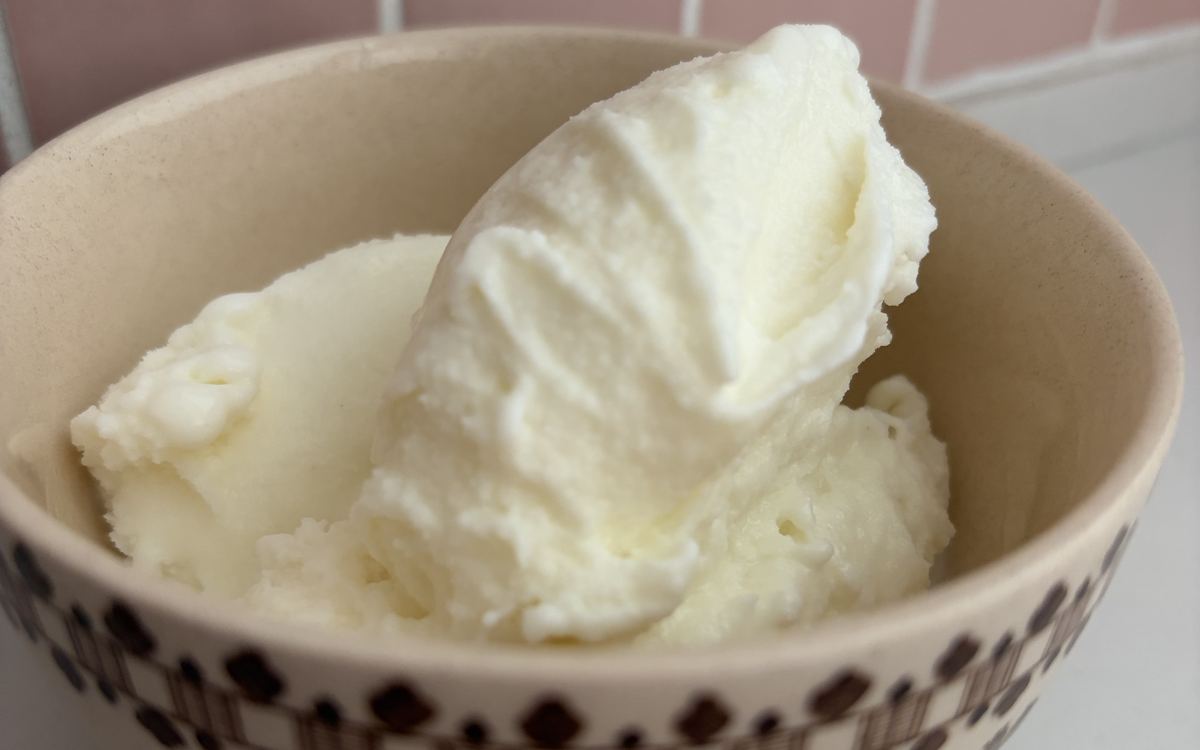
PAC (potere anti-congelante, Italian for anti-freezing power) measures how much the sugars in a gelato recipe lower its freezing point: the higher the PAC, the softer the gelato at the same temperature. POD (potere dolcificante, sweetening power) measures how sweet those same sugars taste. Both are scored against table sugar, which is 100. A dairy gelato aims for a PAC of 22–32 and a POD of 14–21 per 100 g of mix; a sorbet runs higher on both.
That's the whole idea. The rest of this guide shows where the numbers come from, works them out by hand for a real recipe, and shows the one sugar swap that makes gelato softer without making it sweeter. Every number here is what GelatoLator shows for the same recipe, so you can check each step as you go.
PAC and POD in One Minute
Gelato is mostly water. When it freezes, the sugars dissolved in that water make it harder for ice to form, so part of the water stays liquid even at −12 °C. That liquid part is what makes a scoop soft. More dissolved sugar (or the right sugar) means more unfrozen water and a softer gelato.
The trouble is that sugars don't all behave alike. Gram for gram, dextrose fights freezing almost twice as hard as table sugar, yet tastes only about two thirds as sweet. So "how much sugar is in it" can't tell you how soft or how sweet a recipe will be. PAC and POD can, because each sugar carries its own factor for each:
| Dairy gelato | Fruit sorbet | |
|---|---|---|
| PAC (softness) | 22–32 | 30–42 |
| POD (sweetness) | 14–21 | 22–28 |
These are GelatoLator's target bands, per 100 g of mix. Some recipe books and spreadsheets quote PAC per kilo instead, which makes the same numbers ten times bigger: a PAC of 26 per 100 g is the same recipe as 260 per kg. If a forum post says "aim for 240–280", that's the same target written on the other scale.
Why Some Sugars Fight Freezing Harder
Freezing-point depression depends on how many dissolved particles are in the water, not on how heavy they are. Dextrose and fructose are single sugar molecules; sucrose is two of them joined together. So a gram of dextrose puts nearly twice as many particles into the water as a gram of sucrose, and lowers the freezing point nearly twice as much. Bigger molecules, like the long chains in glucose syrup, do the opposite: lots of body, little anti-freezing power.
Sweetness is a separate property of each molecule, which is why the two numbers move independently. That independence is the useful part. It lets you tune softness and sweetness one at a time.
The Sugar Table: POD and PAC for Common Sweeteners
Every value below is per 100 g of the ingredient as you buy it, water included, from GelatoLator's ingredient database. That's why the syrups score lower than you might expect: some of each spoonful is water.
| Ingredient (as sold) | POD | PAC | What it's good for |
|---|---|---|---|
| White sugar (sucrose) | 100 | 100 | The reference; clean sweetness |
| Dextrose (monohydrate) | 64 | 173 | Softer without sweeter |
| Dextrose (anhydrous) | 70 | 190 | Same job, no crystal water |
| Fructose | 173 | 190 | Very sweet and soft; use sparingly |
| Invert sugar (syrup) | 100 | 146 | Softer at the same sweetness |
| Honey | 100 | 150 | Like invert sugar, with flavour |
| Glucose syrup (DE60) | 50 | 92 | Body and chew, mild sweetness |
| Glucose syrup (DE40) | 40 | 64 | More body, firmer |
| Atomized glucose (DE40) | 34 | 78 | Solids without sweetness; sorbets |
| Trehalose | 41 | 90 | Bulk with little sweetness |
| Allulose | 70 | 190 | A low-calorie dextrose stand-in |
| Erythritol | 70 | 280 | Very high PAC; small doses only |
| Rum, bourbon, vodka (40%) | 0 | 247 | Softness with no sweetness at all |
| Kahlua (16%) | 35 | 118 | Alcohol and sugar together |
| Skim milk powder | 8.5 | 53 | Its lactose counts too |
| Whole milk (3% fat) | 0.8 | 5 | Lactose again, a little per gram |
Two things stand out. First, the milk rows: lactose is a sugar, so every gram of milk and milk powder adds a little PAC. In a dairy gelato that adds up to more than you'd think, as the worked example below shows. Second, allulose sits exactly where anhydrous dextrose does (PAC 190, POD 70), which is why it's the most interesting low-sugar option. We're testing it in the kitchen in November, and it gets an article of its own.
How Is PAC Calculated? A Worked Example
Here's the method, and it's the same for POD:
- For each ingredient, multiply its weight in grams by its PAC factor and divide by 100. That's its PAC points.
- Add up the points for the whole recipe.
- Divide by the total weight of the recipe and multiply by 100. That's the PAC per 100 g of mix.
Let's do it for our Fior di Latte, a plain milk-and-cream gelato that weighs 999 g:
| Ingredient | Weight | PAC factor | PAC points | POD factor | POD points |
|---|---|---|---|---|---|
| Milk 3% fat | 650 g | 5 | 32.5 | 0.8 | 5.2 |
| Heavy cream (36% fat) | 150 g | 3.2 | 4.8 | 0.5 | 0.75 |
| Skim milk powder | 50 g | 53 | 26.5 | 8.5 | 4.25 |
| Dextrose (monohydrate) | 30 g | 173 | 51.9 | 64 | 19.2 |
| White sugar (sucrose) | 115 g | 100 | 115.0 | 100 | 115.0 |
| Stabilizer | 4 g | 0 | 0 | 0 | 0 |
| Total | 999 g | 230.7 | 144.4 |
Now divide by the batch weight:
- PAC = 230.7 ÷ 999 × 100 = 23.1
- POD = 144.4 ÷ 999 × 100 = 14.5
Both sit inside the dairy bands (PAC 22–32, POD 14–21), which is why this recipe scoops well and doesn't taste cloying. Load it into GelatoLator and you'll see the same 23.1 and 14.5 in the totals row.
Look at where the PAC came from. The milk, cream and milk powder together contribute 63.8 of the 230.7 points, more than a quarter, and none of it from sugar you added. That's the lactose. It's why a recipe that looks under-sugared on paper can still balance, and why adding milk powder to fix low solids also nudges PAC up.
Load the Fior di Latte and check the numbersFrom PAC to Serving Temperature
A PAC number on its own is abstract. What you actually want to know is: at what temperature will this scoop nicely? GelatoLator estimates it with a simple rule used across the gelato trade: divide the PAC by 2 and put a minus sign in front for a dairy gelato (divide by 2.5 for a sorbet, which is built differently).
For the Fior di Latte, 23.1 ÷ 2 gives a serving temperature of about −11.5 °C. That's a gelateria display case. A home freezer runs at −18 °C or colder, so the same gelato comes out of it firmer than it's meant to be served. That's not a fault in the recipe; it's the temperature. Leave the tub on the counter for 5–10 minutes before scooping, and it softens to where the PAC says it should be. (The timings for every stage, from heating the base to serving, are in How to Make Gelato at Home.)
If you'd rather scoop straight from a home freezer, you need a higher PAC, nearer the top of the band, which means more of the high-PAC sugars. Push it too far, though, and the gelato is soupy in the bowl.
Softer Without Sweeter: The Dextrose Swap
Say the Fior di Latte is too firm for you. There are two ways to raise its PAC, and they taste very different:
| Version | PAC | POD | Serving temp |
|---|---|---|---|
| Original (115 g sucrose, 30 g dextrose) | 23.1 | 14.5 | −11.5 °C |
| Add 30 g more sucrose | 25.3 | 16.9 | −12.7 °C |
| Swap 30 g sucrose for dextrose | 25.3 | 13.4 | −12.6 °C |
Both changes make the gelato equally softer. Only one makes it sweeter. Adding sucrose pushes POD up by 2.4 points, which you'll taste; swapping sucrose for dextrose actually brings POD down a point, because dextrose is less sweet. This is the most useful trick in gelato balancing, and it's the reason professional recipes use more than one sugar.
The same logic runs in reverse. If a recipe tastes too sweet but has the right softness, swap some sucrose for a sugar with lower POD and similar PAC, or move some of the sweetness into glucose syrup for body.
Try the dextrose swap in GelatoLatorAlcohol: PAC With No POD at All
Alcohol takes the dextrose trick to the extreme. It lowers the freezing point far more than any sugar, gram for gram roughly seven times as much as sucrose, and adds no sweetness. A 40% spirit like rum scores PAC 247 and POD 0 per 100 g as it comes from the bottle.
Add 30 g of rum to the 999 g Fior di Latte and the numbers move like this:
- PAC goes from 23.1 to 29.6
- POD drops slightly, from 14.5 to 14.0, because the batch got heavier without getting sweeter
- Serving temperature goes from −11.5 °C to −14.8 °C
That's a bigger jump in softness than the whole dextrose swap, from a couple of tablespoons. It's also why boozy gelato goes wrong so easily: at about 40 g of rum per kilo, this base reaches the top of the dairy band (PAC 32), and past that it stays too soft to hold a scoop. If you add a spirit, cut back some of the dextrose or other high-PAC sugar to make room for it. Sweet liqueurs like Kahlua or amaretto bring sugar as well as alcohol, so they raise both numbers.
Flavourings count too: vanilla extract is about 35% alcohol by volume, so a teaspoon (about 5 g) adds roughly 1 point of PAC to a 1 kg batch. GelatoLator counts it.
Why Sorbet Runs Higher
A sorbet's targets sit well above a gelato's: PAC 30–42 and POD 22–28. With no fat or milk solids to give it body, a sorbet relies on sugar for almost all of its structure, so it needs more of it to stay scoopable. That's also why the serving-temperature rule divides by 2.5 instead of 2: a sorbet at the same PAC is firmer than a gelato.
Fruit adds its own sugars, mostly fructose and glucose, which carry high PAC. Leave them out of the count and the sorbet ends up harder or sweeter than you planned. Why Is My Sorbet Too Hard? works through the sorbet version of this, from the all-sucrose trap to a balanced recipe.
What PAC Doesn't Tell You
PAC is the best single predictor of softness, but it's not the whole story:
- It only counts what's dissolved. Fat, protein and stabilizer don't lower the freezing point, but they change how hard a gelato feels. A high-fat gelato and a low-fat one at the same PAC won't scoop the same.
- Free water still matters. A recipe can hit its PAC and still go icy if total solids are low, because there's too much water left to freeze into crystals. That's covered in Why Is My Gelato Icy?
- PAC ÷ 2 is an estimate. The more exact method models how much of the water is frozen at each temperature. For a home batch the simple rule lands close enough to choose a serving temperature, and it's the rule GelatoLator uses.
Frequently Asked Questions
What does PAC stand for in gelato?
PAC stands for potere anti-congelante, Italian for anti-freezing power. It measures how much the sugars in a recipe lower its freezing point, scored against table sugar at 100. The higher the PAC, the softer the gelato at a given temperature.
What is a good PAC for gelato?
For dairy gelato, aim for a PAC of 22–32 per 100 g of mix. Lower and it freezes too hard to scoop; higher and it turns soupy. Sorbets run higher, at 30–42. If you see 240–280, that's the same range written per kilo instead of per 100 g.
What is the difference between PAC and POD?
PAC measures how soft the sugars keep the gelato; POD (potere dolcificante, sweetening power) measures how sweet they taste. Both use table sugar as 100. They move independently: dextrose has a PAC of about 190 but a POD of about 70, so swapping some sucrose for dextrose makes gelato softer without making it sweeter.
How do you calculate PAC?
Multiply each ingredient's weight in grams by its PAC factor and divide by 100 to get its PAC points. Add the points up, divide by the total recipe weight and multiply by 100. For a 999 g fior di latte with 115 g sucrose, 30 g dextrose and its milk, that gives 230.7 points and a PAC of 23.1.
Does PAC ÷ 2 give the serving temperature?
Roughly, yes, for a dairy gelato: a PAC of 24 means it scoops best at about −12 °C. It's an estimate that ignores fat and solids, but it's close enough for a home batch, and it's the rule GelatoLator uses. Sorbets divide by 2.5. A home freezer runs colder than these targets, so let the tub soften on the counter for 5–10 minutes before scooping.
Does alcohol affect PAC?
Yes, more than anything else in the recipe. A 40% spirit has a PAC of about 247 per 100 g and a POD of 0, so it softens gelato a lot without sweetening it. Adding 30 g of rum to a 1 kg fior di latte raises its PAC from 23 to about 30. Past roughly 40 g of a 40% spirit per kilo, that base gets too soft to hold a scoop.
Can I use honey or allulose to soften gelato?
Yes. Honey (PAC 150, POD 100 as sold) softens gelato at about the same sweetness as sugar, and adds its own flavour. Allulose (PAC 190, POD 70) behaves like dextrose: softer, less sweet, with almost no calories. Erythritol has an even higher PAC of 280, so use it in small amounts.
Put the Numbers to Work
You don't have to do this arithmetic by hand every time. That's what the calculator is for: add your ingredients and GelatoLator works out PAC, POD and the serving temperature as you type, and shows any number that's out of range in red. Doing it once by hand, though, is what makes the red numbers make sense.
For the other numbers on the balance panel (fat, milk solids, total solids, stabilizer), see How GelatoLator Works. To take a recipe you found online and fix its PAC, POD and everything else, the recipe-conversion guide walks through it step by step. And for two bases with every number already in the green, start from The Ultimate Vanilla Gelato Base.
Open GelatoLator and check your recipe's PAC